







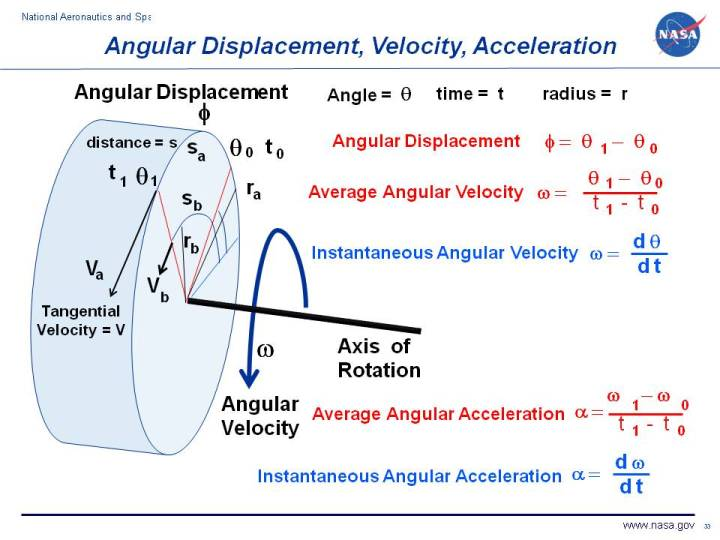
Angular velocity is a fundamental concept in physics that explains how quickly an object rotates around an axis. From spinning ceiling fans and bicycle wheels to electric motors and planetary motion, angular velocity helps describe rotational movement in everyday life. Understanding its definition, formula, SI unit, and practical applications makes circular motion easier to understand. Whether you are a student studying physics or a beginner exploring mechanics, learning this concept provides a strong foundation for understanding rotational motion.
In this comprehensive guide, you will learn how angular velocity works, how to calculate it using different formulas, and how it relates to angular speed, frequency, period, and linear velocity. You will also discover real-world applications, explore solved numerical examples, and review common mistakes to avoid when working with rotational motion equations. These explanations use straightforward language and practical examples to make the topic accessible to students and readers interested in science.
What Is Angular Velocity?
Angular velocity is the rate at which an object’s angular position changes over time as it rotates around an axis. It describes how quickly an object turns and, in three-dimensional physics, identifies the direction of its rotation. The standard symbol is the Greek letter omega (ω). Unlike linear velocity, which describes movement along a path, angular velocity focuses on rotational displacement and the time required for that change.
Consider a ceiling fan rotating in a room. When the fan spins slowly, its angular velocity has a relatively small magnitude, but when the speed increases, its angular velocity magnitude increases as well. The same principle applies to bicycle wheels, electric motors, and rotating machinery. These everyday examples demonstrate why angular velocity is useful for explaining how objects rotate, comparing rotational rates, and solving physics problems involving circular motion.
Angular Velocity Formula and Equation
The standard formula for average angular velocity is ω = Δθ / Δt. In this equation, ω represents average angular velocity, Δθ represents the change in angular displacement measured in radians, and Δt represents the elapsed time measured in seconds. The equation shows that rotational displacement divided by the time taken gives the average rotational rate during a particular interval.
For example, imagine a wheel rotating through an angular displacement of 8 radians in 4 seconds. Using the formula, divide 8 radians by 4 seconds to obtain an average angular velocity of 2 rad/s. This straightforward calculation illustrates how the formula works in practice. When the question involves rotation at a particular instant rather than an interval, instantaneous angular velocity can be expressed as ω = dθ/dt, representing the rate of change of angular position with respect to time.
Angular Velocity Symbol, SI Unit, and Dimensions
The symbol for angular velocity is omega (ω), and its standard SI unit is radians per second (rad/s). This unit expresses the amount of angular displacement an object completes in one second. Other common units include degrees per second and revolutions per minute (RPM). Because different scientific and engineering applications use different measurement systems, converting between these units is often necessary when solving rotational motion problems.
The dimensional formula of angular velocity is [T⁻¹], which represents inverse time. Angular displacement in radians is dimensionless, so angular velocity has the same fundamental dimension as frequency. To convert RPM into radians per second, multiply the rotational rate by 2π/60. For example, a wheel rotating at 60 RPM has an angular velocity of 2π rad/s, approximately 6.28 rad/s. Using the correct unit helps prevent errors when comparing rotational rates or applying physics equations.
How to Calculate Angular Velocity Step by Step
Calculating angular velocity begins with identifying the angular displacement and the time interval. First, determine how far the object rotates, convert the angle into radians if necessary, and record the elapsed time in seconds. Next, divide the angular displacement by the elapsed time. Finally, express the result in radians per second and check that the values and units are consistent with the information provided in the question.
For example, suppose a rotating disk completes half a revolution in 2 seconds. Half a revolution equals π radians, so its average angular velocity is π/2 rad/s, or approximately 1.57 rad/s. This example demonstrates how rotational displacement can be converted into a useful numerical answer. If the problem instead provides the time needed for one complete revolution, you can use the period-based formula, ω = 2π/T, where T represents the time period in seconds.
Angular Velocity, Period, and Frequency
Period and frequency are closely connected to rotational motion. The period, represented by T, is the time required for an object to complete one full revolution. Frequency, represented by f, measures the number of complete revolutions per second and is measured in hertz (Hz). A rotating object with a shorter period completes each revolution more quickly, while a higher frequency means that more rotations occur during the same amount of time.
The relationship between angular velocity and frequency is expressed as ω = 2πf. For example, if a motor rotates at a frequency of 3 Hz, its angular velocity is 2π × 3, which equals 6π rad/s or approximately 18.85 rad/s. The period-based relationship is ω = 2π/T for steady rotation. These formulas are useful when the problem provides frequency or period instead of angular displacement and elapsed time.
Angular Velocity vs. Angular Speed
Angular speed and angular velocity are related concepts, but they are not exactly the same. Angular speed describes how quickly an object rotates without specifying its direction. Angular velocity includes both magnitude and direction, making it a vector quantity in standard three-dimensional physics. Both measurements are important for understanding rotational motion, but the distinction becomes especially useful when comparing objects rotating in different directions.
Imagine two identical wheels rotating at the same rate, with one turning clockwise and the other counterclockwise when viewed from the same side. Their angular speeds can be equal, but their angular velocity vectors point in opposite directions. This distinction matters in physics calculations involving rotation, changing direction, and angular acceleration. Recognizing the difference helps students interpret formulas correctly and avoid treating directional information as though it were simply a numerical speed.
Angular Velocity vs. Linear Velocity
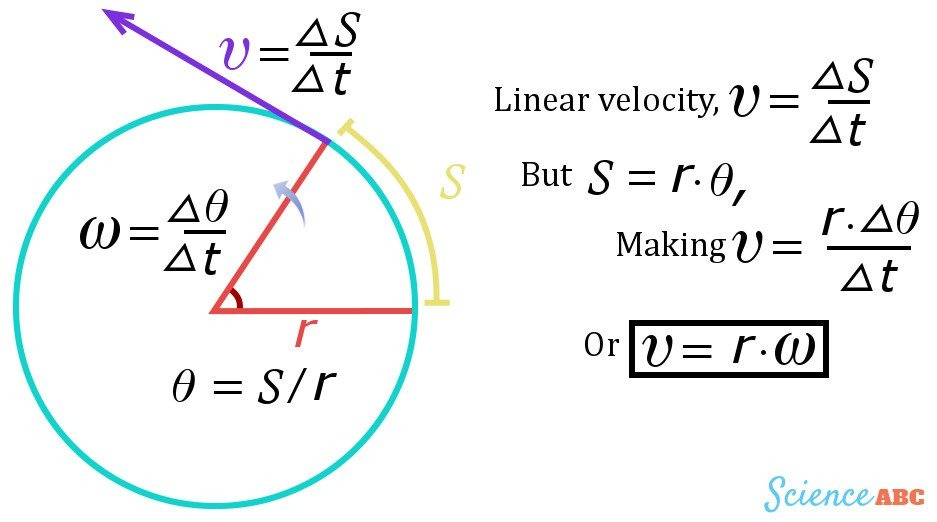
Linear velocity describes how quickly an object changes position along a path, while angular velocity describes the rate at which its angular position changes. In circular motion, the tangential linear velocity of a point on a rotating object is related to angular velocity through the equation v = rω. Here, v represents tangential velocity, r represents the distance from the axis of rotation, and ω represents angular velocity.
This relationship explains why points farther from the center of a rotating wheel travel faster along their circular paths when the entire wheel rotates at the same angular rate. For example, if a point lies 0.5 meters from the axis and the angular velocity is 4 rad/s, its tangential speed is 2 m/s. Angular velocity is measured in rad/s, whereas linear velocity is measured in meters per second. Both measurements describe different aspects of the same rotational movement.
Direction of Angular Velocity and the Right-Hand Rule
Angular velocity has a direction associated with the axis of rotation. The right-hand rule is a convenient way to determine this direction in three-dimensional physics. To apply it, curl the fingers of your right hand in the direction of rotation. Your extended thumb points along the angular velocity vector. This method provides a consistent way to represent rotational direction in mathematical equations and engineering diagrams.
For example, when a wheel rotates around a horizontal axle, its angular velocity vector points along the axle rather than following the circular path of the wheel’s rim. The direction depends on the direction of rotation and the viewing reference. A clockwise rotation viewed from one side appears counterclockwise from the opposite side. For this reason, physics problems should identify the viewing direction or coordinate system whenever directional information is important.
Angular Velocity in Uniform and Nonuniform Circular Motion
Uniform circular motion occurs when an object travels around a circular path with constant angular velocity, provided the rotation axis and direction remain fixed. Although the angular velocity vector stays constant in this situation, the object’s linear velocity continually changes direction as it moves around the circle. This distinction helps explain why an object can experience acceleration even when its rotational rate remains unchanged.
Nonuniform circular motion occurs when an object’s rotational rate changes over time. Angular acceleration, represented by the Greek letter alpha (α), describes the rate of change of angular velocity. Its average value can be calculated using α = Δω/Δt. For example, when a motor speeds up after being switched on, its angular velocity increases. When the motor slows down, its angular velocity magnitude decreases. These relationships help engineers analyze rotating machines and moving mechanical systems.
Real-Life Applications of Angular Velocity
Angular velocity has practical applications in household appliances, transportation, manufacturing, and scientific research. Electric motors rely on rotational motion to power machines, while bicycle wheels and vehicle tires demonstrate the connection between rotation and forward movement. Engineers use rotational measurements to analyze machinery, monitor motor performance, and design systems that operate at particular rotational rates. Understanding angular velocity also helps explain how different parts of a rotating mechanism move together.
The concept is equally useful in astronomy and navigation. Earth rotates around its axis, while planets move along their orbital paths around the Sun. These are different types of motion: axial rotation describes an object’s spin, whereas orbital motion describes movement around another body. Gyroscopes also use rotational behavior in navigation and stabilization systems. From industrial equipment to space science, angular velocity provides a mathematical way to describe and analyze rotating objects.
Common Mistakes When Solving Angular Velocity Problems
One common mistake is confusing angular velocity with linear velocity. Although the two quantities are related, they describe different types of motion and use different units. Another frequent error is substituting an angle measured in degrees into a formula that expects radians without performing the required conversion. Students should also check whether a rotational rate is expressed in RPM, revolutions per second, or radians per second before beginning a calculation.
Other mistakes include confusing frequency with period, forgetting to include units, and overlooking the direction of the angular velocity vector when a question involves rotation in three dimensions. Reading the problem carefully helps identify the correct formula and the information needed to solve it. After calculating an answer, check whether its magnitude is reasonable and whether the units match the quantity requested. These simple habits improve accuracy and build confidence when working with rotational motion equations.
Angular Velocity Practice Problems With Answers
Practice problems help reinforce the formulas and make rotational motion easier to understand. Start by identifying the known quantities, selecting the appropriate equation, and substituting the values carefully. When a question involves angular displacement and time, use the average angular velocity formula. When frequency or period is provided, use the corresponding relationship. Showing the calculation step by step also makes it easier to identify mistakes and understand why the answer is correct.
Consider these examples. A wheel rotates through 12 radians in 4 seconds, giving an average angular velocity of 12/4 = 3 rad/s. If another object rotates at a frequency of 5 Hz, its angular velocity is 2π × 5 = 10π rad/s, approximately 31.42 rad/s. Finally, a wheel with a radius of 0.5 meters rotating at 4 rad/s has a tangential speed of 0.5 × 4 = 2 m/s. Each example demonstrates a different relationship used in rotational motion.
Conclusion
Angular velocity is an essential physics concept that describes the rate of change of angular position over time. Its standard formula, ω = Δθ/Δt, helps calculate average rotational motion, while relationships involving frequency and period provide alternative methods for solving problems. Understanding the symbol, SI unit, dimensional formula, and direction of angular velocity makes it easier to interpret equations and distinguish rotational motion from linear movement.
From spinning fans and bicycle wheels to electric motors, planetary motion, and gyroscopes, angular velocity connects basic physics principles with practical applications. Learning how to convert units, use the right-hand rule, and select the appropriate formula can improve both conceptual understanding and numerical problem-solving skills. With regular practice and careful attention to units, students can develop a stronger foundation in circular motion and rotational mechanics.
Frequently Asked Questions
What is angular velocity in simple terms?
Angular velocity describes how quickly an object rotates around an axis and identifies the direction of that rotation. It is useful for understanding rotating wheels, fans, motors, and other objects that move in circular paths. Its standard symbol is omega (ω), and its SI unit is radians per second. The concept helps explain rotational motion in physics and provides a foundation for understanding more advanced topics involving circular movement and mechanical systems.
What is the formula for angular velocity?
The average angular velocity formula is ω = Δθ/Δt, where Δθ represents the change in angular displacement measured in radians and Δt represents elapsed time in seconds. For an object completing steady rotations, angular velocity can also be calculated using ω = 2πf, where f is frequency, or ω = 2π/T, where T is the period. The best formula depends on which quantities the question provides.
What is the SI unit of angular velocity?
The SI unit of angular velocity is radians per second (rad/s). It describes the angular displacement an object covers each second. Other units, such as degrees per second and revolutions per minute, are also used in practical situations. However, converting values into radians per second is often helpful when working with standard physics equations. Keeping the units consistent ensures that calculations involving rotational motion produce meaningful results.
What is the difference between angular speed and angular velocity?
Angular speed describes the rate at which an object rotates, without including directional information. Angular velocity includes both the magnitude of rotation and its direction, so it is treated as a vector quantity in standard three-dimensional physics. Two wheels may rotate at the same angular speed but have opposite angular velocity vectors if they turn in opposite directions. Understanding this difference is important when analyzing rotational movement and solving physics problems.
How is angular velocity calculated from frequency?
Angular velocity can be calculated from frequency using the equation ω = 2πf. Frequency represents the number of complete rotations per second and is measured in hertz. For example, an object rotating at 2 Hz has an angular velocity of 4π rad/s, approximately 12.57 rad/s. This relationship is especially useful when the rotational frequency is known but the angular displacement and elapsed time are not provided separately.
How are angular velocity and linear velocity related?
Angular velocity and tangential linear velocity are connected by the equation v = rω. In this formula, v is tangential velocity, r is the distance from the axis of rotation, and ω is angular velocity. When the angular velocity remains constant, points farther from the axis have greater tangential speeds. This relationship explains how different points on a rotating wheel can share the same angular rate while moving at different linear speeds.
Is angular velocity a scalar or a vector quantity?
Angular velocity is treated as a vector quantity because it has both magnitude and direction. Its direction lies along the axis of rotation and can be identified using the right-hand rule. Angular speed, in comparison, is a scalar quantity because it describes only the magnitude of rotational motion. This distinction becomes important when analyzing rotation in three dimensions, comparing opposite directions, and studying angular acceleration in physics.
How do you convert RPM into radians per second?
To convert revolutions per minute into radians per second, multiply the RPM value by 2π/60. One complete revolution equals 2π radians, and one minute contains 60 seconds. For example, a motor rotating at 120 RPM has an angular velocity of 120 × 2π/60 = 4π rad/s, approximately 12.57 rad/s. This conversion is useful when motor specifications provide rotational speed in RPM but a physics calculation requires radians per second.
What is the dimensional formula of angular velocity?
The dimensional formula of angular velocity is [T⁻¹], representing inverse time. Angular displacement measured in radians is dimensionless, so dividing angular displacement by time gives the dimension of inverse time. This dimensional relationship is useful for checking equations and identifying incorrect units. Although angular velocity and frequency share the same fundamental dimension, they represent different physical quantities: one describes rotational motion, while the other measures the number of cycles completed per unit time.
What are some real-life examples of angular velocity?
Common examples include rotating ceiling fans, spinning bicycle wheels, electric motors, vehicle tires, and Earth’s rotation around its axis. Scientists and engineers also use angular velocity when studying planetary motion, robotic joints, industrial machinery, and gyroscopes. These examples demonstrate how rotational rates affect everyday technology and natural processes. Understanding the concept helps explain how quickly objects turn and how their rotation relates to time, distance, and other physical quantities.